
Interactive fiction you play for weeks. Local-first, free
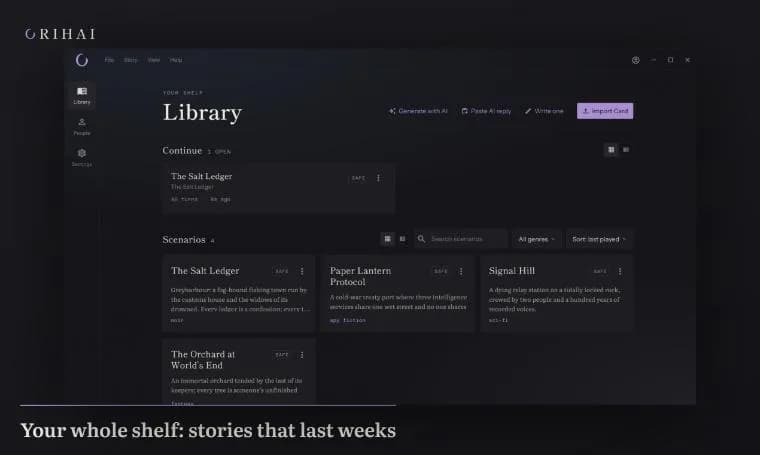
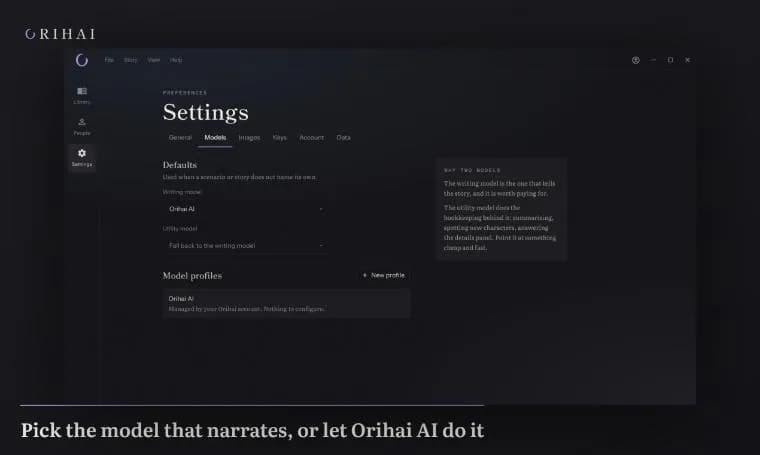
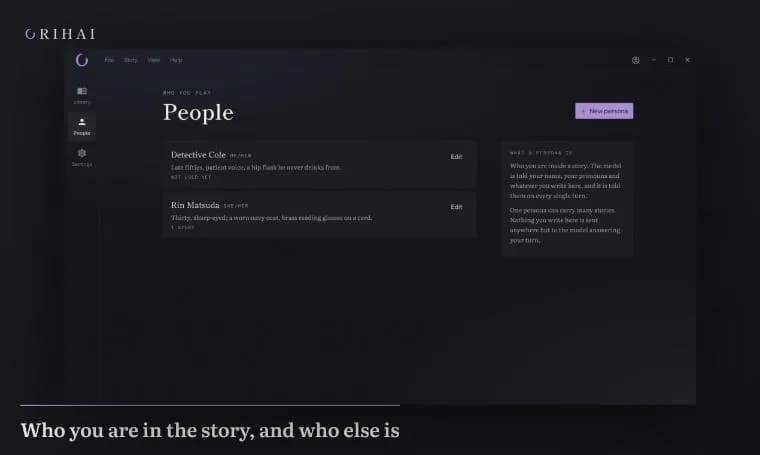
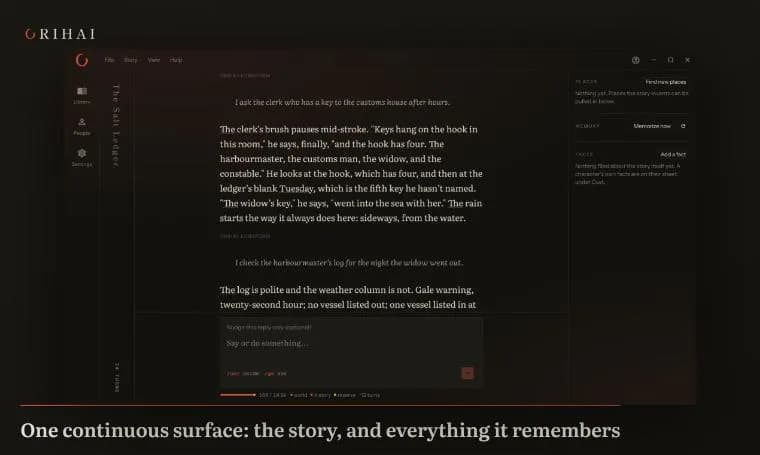
What it does. Orihai is a Windows desktop app for long interactive fiction: stories you play over weeks rather than minutes. You pick a scenario, cast the people in it, and read a continuous narrated story you steer turn by turn.
How it works. Every turn is compiled into a budgeted context that tracks who is who, where they are, and what was promised, so the narrator stays true to a story that is now hundreds of turns long, instead of drifting into a different one. Names in the prose light up: hover to see who that is and where they last appeared.
Where it runs. Entirely on your machine. Your stories are one database file; your API key lives in the Windows credential store; there is no server in the middle. Bring a key for Anthropic, OpenAI, OpenRouter or any OpenAI-compatible endpoint, or bring none at all and run fully local through Ollama, LM Studio or llama.cpp. Seven hand-tuned themes, two of them for daylight reading.
Price. The app is free, and always will be, with your own key or a local model. There is also a managed service, Orihai AI, for people who would rather not handle keys: its plan is free while it is in testing, and paid plans may come later. Bring-your-own-key and local use stay free either way.
Feedback wanted. Does the prose hold up over weeks of play? Which theme do you read in? What breaks first, and on which model?
Share. Open a scenario's menu in the library, or press Share in the editor, and Orihai saves one file: title.orihai. It holds what the author wrote: the world sheet, the style, the characters, the opening scenes, the lore, and the places.
What it never holds. Anything from a playthrough. Since 0.8.0, a story keeps its own copy of the scenario from the moment it starts, so what happens in your story stays in your story, and editing the scenario changes the next story you start, never the one you are in. A shared file also carries no persona, no model profile, no key, and no images.
Open one. Double-click it or drag it onto the library. Every route ends at the same preview, which shows what is coming before anything is saved.
Also in 0.8.0: a form with unsaved changes asks before it closes, before an update installs, and before the app quits; and the first launch after an update says what changed.
There is no catalogue yet. Share scenarios wherever you already talk about them, and tell us what you made. The app is free either way.
No feedback yet. Be the first to review!
Sign in to join the discussion.
No comments yet. Be the first!

@mraya
Manuel Raya
Showcase your Ignitae presence on your website or README.
[](https://ignitae.com/p/orihai?utm_source=badge&utm_medium=badge&utm_campaign=embed)<a href="https://ignitae.com/p/orihai?utm_source=badge&utm_medium=badge&utm_campaign=embed"><img src="https://ignitae.com/badge/orihai.svg" alt="Ignitae - 1 upvotes" /></a>Chapters. Right-click a turn and start a chapter there. The story gets a table of contents on the spine: rename a chapter, delete a break, or ask the bookkeeping model for three names and keep one. The division is the reader's; nothing is chaptered for you.
A second model reads the reply. Every narrator reply is audited before it reaches the page. If it speaks for your character, knows something it should not, or contradicts an earlier turn, it is redrawn once with the verdict on the tail, and the turn carries a note. One extra utility call on the cheap model.
Who believes what. A character who was not in the room does not know what happened in it. Money and possessions are slots. A fact you edit by hand outranks the extractor over the turns you wrote it on.
/gm. Step outside the story. Ask what has been established, and the answer comes from the record, in a notebook beside the page. Or say where the next few turns should go.
Also: a nudge the model can read, an undo for the writer, a line break in the composer, a paste that keeps its paragraphs, and the gateway's notices in the reader's language.
Orihai AI, the managed option with no key to find, is now the site's first offer; its plan stays free while in testing. The app is free either way.
Still Windows. Still one file on your machine. What breaks for you, and on which model, is the roadmap.
Thank you for the first week. Orihai went public on 4 September, and the people who came through this directory read further into a story than anyone we had tested with. Several of the reports were precise enough to fix from.
What is new.
Turns spend fewer tokens now. A week of real play showed how much of each turn was work already done: the rules that keep the narrator in character were framed from scratch on every request, and on the managed service they were paid for from scratch as well. The framing is now built once, and Orihai AI keeps it in a warm cache rather than resending it whole.
This reaches every way of playing. With your own key, it is a smaller bill from your provider; on a local model, it is less work per turn on your own machine; on Orihai AI, the managed option for readers who would rather not handle a key, it is the largest of the three, and it is part of what keeps that plan free while it is in testing. It is already running, with nothing to click.
What is next. A macOS build in the coming weeks. We are looking for readers with a Mac to test it before it ships, because we do not have Apple hardware here at the moment. If you have a Mac and an evening, get in touch through the listing or at orihai.com.
Unchanged: Your stories are a single database file on your own machine, your keys live in the system credential store, there is no server in the middle, and the app is free and always will be.
Raphael AI
AI / ML
Raphael AI, a free AI image generator, text to image in seconds


